Question: Gas vs steam vs electric commercial tumble dryer — which fuel type gives the lowest cost per kg for a laundromat in California?
Standing in a raw, half-built laundromat shell while your contractor dumps a stack of utility specs on your lap is a classic rite of passage. Gas lines or heavy electrical drops? Call that wrong, and it will silently bleed your monthly P&L for the next decade.
According to Coin Laundry Association tracking, utilities chew up 25% to 30% of a store’s gross revenue, and your dryer bank is the heavy hitter taking the lion’s share of that energy.
Feed 15kg of damp terry towels into a gas-heated commercial tumbler at standard US utility rates, and you’re looking at roughly $0.18 to $0.32 per cycle—assuming gas runs $1.50–$2.50 a therm with the burner humming along at 83–88% efficiency. Swap those same tumbling drums over to electric resistance heating, though, and watch your per-load cost double to $0.40–$0.65 for the exact same pile of laundry.
Now, look at the big picture. Take a busy 30-machine shop running 12 cycles a day. That minor-looking 22-cent spread per load snowballs into an eye-watering $28,000 annual electricity penalty.
What about steam? It occupies a weird middle ground. Unless your commercial landlord already pipes an active boiler plant into the building, steer clear—standalone boiler inefficiencies eat up 12% to 18% of your energy right off the top, completely swallowing any fuel savings you hoped to capture.
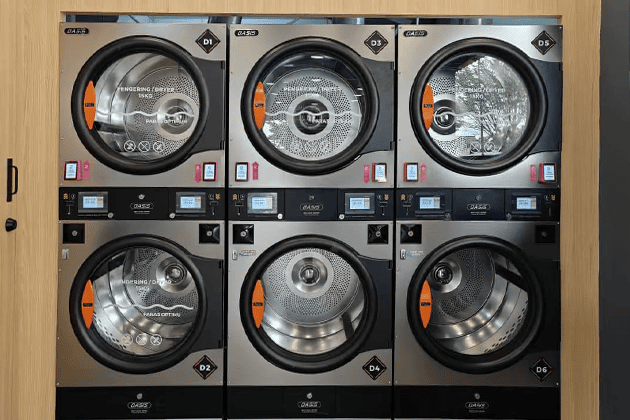
Here is the kicker most people miss: drying costs are largely decided before the clothes even reach the drum. A standard 200 G washer extractor leaves towels at 55–60% residual moisture (RMC). Drop them into an Oasis SXHG-150F stacked unit running at 300 G, and that RMC drops down to roughly 48%. That is 25% less water your dryer has to boil off, slashing your utility bill whether you hook up gas or electric.
The Verdict:
If you have gas lines available at standard rates, run gas—it cuts your per-kg energy cost by over half. But remember to fix your extraction efficiency first, because a high-spin washer is your real secret weapon.
Customer Installations